Applying for Microsoft nonprofit grants is a straightforward process: first, you need to confirm your organisation meets Microsoft’s eligibility criteria, then register with a local validation partner to verify your nonprofit status. Once verified, apply through the Microsoft Nonprofit Portal.
If you’re a nonprofit organisation looking to cut costs and make the most of available discounts to move your mission forward, getting Microsoft nonprofit status is a great option.
In this blog post, we’ll look at the specific steps to get your Microsoft nonprofit status approved, along with Microsoft nonprofit eligibility criteria and all the fantastic benefits that come with Microsoft charity licensing.
Keep on reading to find out:
- What is Microsoft’s nonprofit status and Microsoft charity licensing
- How to apply for NPO and charity status
- The requirements to obtain Microsoft nonprofit status
- How they can benefit your charity
- How to use a nonprofit Microsoft license
- Tips and steps for a successful application
What is Microsoft Nonprofit Status and Microsoft Charity Licensing?
Charities and not-for-profits are organisations that must have exclusively ‘charitable purposes’ that help the public. Nonprofit status is an organisational designation given by certain governments or other authorised entities to registered organisations whose purpose lies in providing charitable services to those in need.
Organisations with nonprofit status have the opportunity to gain access to resources such as discounted rates from vendors, government grants, and more that can help these organisations further their causes even more.
Microsoft charity licensing, part of the “Microsoft for Nonprofits” program, provides eligible charitable organisations with access to grants and discounts on a wide range of products and services.
How to apply for NPO and charity status with Microsoft?
The first step is finding out whether your organisation meets the Microsoft nonprofit status criteria. To do that, simply head over to Microsoft’s charity status overview, where you can run an eligibility pre-check to determine if your organisation is eligible. They offer step-by-step instructions to make this process as easy as possible.
If your charity is eligible, hit ‘apply’ and follow the instructions.
What are the requirements to get Microsoft’s nonprofit status?
Microsoft’s nonprofit eligibility criteria focus on three main elements:
- Organisation
- Mission
- Non-discrimination
Let’s dive a bit deeper into each of the Microsoft charity eligibility criteria on the list.
Organisation
Microsoft charity eligibility outlines that a qualifying organisation must be a:
- A legally recognised nonprofit or non-governmental organisation in their country (equivalent to 501(c)(3) status in the United States).
- A public library offering free general library services to all residents within its service area.
- A public museum, whether publicly or privately operated, that is open to the public, dedicated to preserving and displaying tangible objects and focused on cultural preservation, education, or aesthetic appreciation.
Mission
It is not enough to just meet the 3-point criteria above. To meet Microsoft charity licensing eligibility criteria, such organisations must also operate on a not-for-profit basis and have a mission focused on serving the local community. This encompasses a wide range of activities, including:
- providing relief to the poor and underprivileged
- advancing education
- improving social welfare
- preserving cultural heritage
- protecting or restoring the environment
- promoting human rights, just to list a few.
Non-discrimination
The last point under the Microsoft nonprofit eligibility criteria is non-discrimination. Microsoft is committed to honouring and promoting individual and cultural differences and fostering an inclusive environment free from any form of discrimination.
Microsoft’s commitment to inclusivity means that it cannot support organisations that discriminate based on characteristics such as race, gender, sexual orientation, age, disability, or religious beliefs. Therefore, organisations with discriminatory missions or without any policies in place to prevent discrimination are not eligible to participate in the Microsoft nonprofit program. The full list of criteria can be found under Microsoft’s eligibility criteria.
Find out more about promoting inclusivity in the workplace with Microsoft Teams Accessibility Features.

3 Steps to get Microsoft nonprofit status successfully
1. Check eligibility criteria
Check Microsoft’s guidelines carefully to ensure your organisation meets all the eligibility criteria to receive nonprofit status; prepare necessary legal documentation and relevant certifications/registrations, including:
- (e.g., 501(c)(3) status in the U.S.)
- Tax ID / Charity number (like an EIN in the U.S. or Charity Commission number in the UK).
- Proof of mission (sometimes Microsoft asks for your website or documents showing your charitable purpose).
- Remember to use an official email address for your application.
2. Make sure you’re registered with a charity house
You need to be registered with a charity house before applying for a Microsoft charity status. This can be achieved through Charity Digital. Charity Digital is known for helping charities #BeMoreDigital through inspiring content, access to the UK’s only discounted and donated technology platform and connection to the best digital talent in the sector.
3. Review all Licensing
Make sure to review all available Microsoft charity licensing, including ensuring whether Microsoft 365 Business or Enterprise packages are right for your organisation.
4. Apply Through the Microsoft Nonprofits Portal
- Go to: Microsoft Nonprofit Portal.
- Sign in with a Microsoft account (or create one).
- Complete the registration form, uploading your proof of nonprofit status.
- Submit your application.
5. Wait for Verification
- Microsoft partners with local validation partners to verify eligibility.
- Verification usually takes 3–10 business days.
- You may be contacted for additional documents.
6. Activate Nonprofit Offers
After submitting the application, you must wait for Microsoft’s approval. Once approved, the organisation gains access to various tools and services at a free or discounted rate to help focus on its mission.
Don’t miss a single step in securing your nonprofit’s technology savings: watch the full video walkthrough to master the Microsoft Nonprofit application process!
In this video, we explain:
-
Overview of the Program
-
Eligibility Requirements: To qualify, an organisation must meet specific criteria:
-
Legal Status
-
Not-for-profit Operation
-
Alternative Entities: Public libraries and museums that serve the community are also eligible.
-
Anti-discrimination: Must strictly adhere to Microsoft’s anti-discrimination policy.
-
-
How to Apply
-
Post-Application Process
Common Problems and Mistakes During Microsoft’s Nonprofit Status Validation Process
Microsoft’s verification systems are very strict. The most common problems that charities may encounter during the eligibility checks for getting non profit status on Microsoft are:
-
Identity & Documentation Mismatches
If the information on the application doesn’t exactly match government records, it will be flagged.
- Name Mismatches: Using a “Doing Business As” (DBA) name instead of the official legal name on the tax paperwork.
- Address Errors: Using a home address when the official registration uses an office address.
- Generic Emails: Applying with a @gmail.com or @outlook.com address instead of a professional domain (e.g., @charityname.org).
-
Ineligible Mission Activities
Even if you are a registered 501(c)(3), Microsoft excludes certain types of nonprofits because they often have their own separate licensing programs (like Education or Government).
|
Category |
Common Eligibility Problems |
|
Healthcare |
Most hospitals, healthcare networks, and ambulatory clinics are excluded. Exceptions: Community health clinics, hospices, and emergency services usually are eligible. |
|
Education |
K-12 schools, colleges, and universities must use Microsoft Academic pricing instead. Nonprofit status does not override this exclusion. |
|
Politics/Lobbying |
Organizations primarily focused on legislative advocacy or political campaigning are strictly ineligible. |
|
Professional Orgs |
Commerce and trade associations, labour unions, and fraternal organisations (like many Elks or Moose lodges) are often denied. |
-
Structural & Tenant Red Flags
- The “Multiple Tenant” Trap: Microsoft allows only one nonprofit-validated tenant per organisation. If a previous employee started a trial years ago and you are now trying to start a “fresh” one, the system will flag it as a duplicate. You must reclaim the original tenant rather than create a new one.
- User Mis-Licensing: Grants are intended for paid employees and executive leadership only. If Microsoft’s validation partner suspects you are trying to use free “Donation” licenses for “members,” “donors,” or “beneficiaries” (e.g., a church giving licenses to its congregation), they will deny the status.
- Low Usage Rates: Microsoft now requires at least an 85% active usage rate for granted (free) licenses. If you have 50 free seats but only 5 people actually log in, you risk losing your eligibility during an audit.
-
The “Non-Discrimination” Clause
As mentioned, Microsoft requires an attestation (and sometimes proof) that your organisation does not discriminate in hiring or service delivery.
However, organisations with missions that are inherently exclusive (even if for religious reasons) may face hurdles unless they can demonstrate compliance with Microsoft’s specific anti-discrimination policy.
Major Benefits of Microsoft Grants And Non Profits
Nonprofits can get multiple benefits from Microsoft Grants for charities: from enhanced technology that can advance their mission, to improved donor management and huge cost savings that these grants offer.
Here’s what your organisation can gain by getting “Microsoft Nonprofit” status:
- Access to Microsoft 365 & Office tools at low or no cost. Eligible nonprofits can get free or heavily discounted licenses for Microsoft 365, Office apps, and related services.
- Access to Dynamics 365, and data tools for donor/constituent management, campaign tracking, and program operations.
- Power Platform tools (Power BI, Power Apps, Power Automate) may also be included or discounted, letting organisations build custom apps, automate workflows, and analyse data without heavy development costs.
- Promotional / advertising grants. Microsoft has a “Ads for Social Impact” grant, which gives nonprofits a monthly advertising credit
- Better security, compliance and management tools. Through the nonprofit offers, organisations can access enterprise-grade security, identity, compliance, device management, and threat protection features.
- Scalability and flexibility. Because many of Microsoft’s offerings are cloud-based, nonprofits can scale up or down usage, resources, storage, etc.
Microsoft’s support for charities extends beyond just Word and Excel. Eligible organisations can also access specialised tools for talent, code, and equipment:
- LinkedIn for Nonprofits: Gain access to discounted professional tools designed to help your charity find the right talent, engage with major donors, and expand your mission’s reach.
- GitHub for Nonprofits: Tech-focused charities and developers can access GitHub Enterprise at a reduced rate, providing a secure, professional environment for building and managing software.
- Hardware & Surface Grants: Through specific Microsoft partners, charities can occasionally secure donated or heavily discounted Surface devices and accessories to help get their teams mobile.
Changes to Microsoft Nonprofit Grants
Something important to keep in mind is that Microsoft has announced changes to its nonprofit grant structure starting July 1, 2025.
Microsoft retired its popular grants that provided 10 free Business Premium seats and unlimited Office 365 E1 access. For most organisations, these plans have now transitioned to a paid, albeit heavily discounted, model at their first renewal date following that deadline.
While this change added a new line item to many charity budgets, it hasn’t removed access to the tools themselves; instead, it has created a moment for teams to audit their tech stacks. Many have chosen to move to Microsoft 365 Business Basic, which remains free for up to 300 users, while others are investing in the paid Premium tier to maintain the high-level security and desktop apps their operations require.
Who and How You Can Use The Microsoft License As a Nonprofit?
How?
Microsoft Grants are available to eligible nonprofit organisations. This includes receiving grants for cloud services like Microsoft 365, Azure and Dynamics 365, Surface hardware, on-premises software, access to resources and digital skilling, as well as free software licenses for charities.
Under the Microsoft charity licensing, Microsoft also offers discounted licenses to eligible nonprofits, which are applicable to all services that grants apply to, mentioned above.
Who?
The image below details who is able to use the Microsoft nonprofit license within a nonprofit organisation. It includes grant offers, discounts and volunteer benefits. The type of Microsoft license available to nonprofit employees depends on their role and status within the organisation.
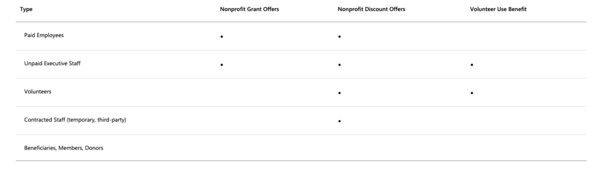
Source: Microsoft
Conclusion
In conclusion, if your organisation is looking to make use of the available support and discounts out there, then applying for nonprofit status through Microsoft is definitely worth considering. With it comes access to plenty of resources that can help propel any mission forward into a success!
Microsoft Status Free Consultation
Need some advice on getting Microsoft charity status? Contact us for a free consultation with our experts by clicking the button below.
Microsoft Nonprofit Status FAQ
Is not-for-profit a legal status?
The term “not-for-profit” is a broad description, not a specific legal status; it simply means an organisation reinvests any surplus into its mission instead of distributing it to shareholders.
To qualify for formal benefits like grants, tax exemptions, or programs such as Microsoft’s nonprofit licensing, an organisation must possess a recognised legal structure granted by the relevant authority. It is the official legal registration that ultimately determines eligibility for specific programs and benefits.
Is Microsoft 365 free for charities in the UK?
Microsoft’s Nonprofit Staff Pricing offers significant value across its Microsoft 365 plans, designed to fit different organisational needs and budgets. The entry-level Business Basic plan is provided as a grant (free) for up to 300 users, offering core cloud services like Teams, custom email, and web versions of Office apps.
For organisations requiring the full desktop applications, the Business Standard plan is available at the highly discounted rate of £2.30 per user/month, paid yearly. Finally, the top-tier Business Premium plan, which includes advanced security and device protection, is also heavily discounted at £4.20 per user/month, paid yearly. For more information about Microsoft’s plans, read our blog ‘Ultimate Guide to Microsoft 365 for Charities’.
Does a not-for-profit organisation need to be registered?
The necessity for a “not-for-profit” organisation to be registered depends on its goals, activities, and location.
Generally, an organisation doesn’t legally have to be called “not-for-profit,” but to gain any formal benefits, such as tax-exempt status (e.g., 501(c)(3) in the U.S.), the ability to receive tax-deductible donations, or eligibility for grants and discounted programs (like Microsoft’s), it absolutely must register as a specific legal entity
How long does it take to get approved?
Microsoft usually processes eligibility requests within three business days. However, this can take longer if they need extra documentation or if there is a delay in responding to their follow-up questions.
How long does my nonprofit status last?
Once you are validated, your status doesn’t have a fixed “expiration date,” but it isn’t permanent without action. Microsoft requires you to periodically re-confirm (attest) that your organisation still follows their donor rules and anti-discrimination policies.
What is Microsoft non profit?
Microsoft for Nonprofits is a global initiative (often under the banner of Microsoft Philanthropies or Tech for Social Impact) that provides eligible nonprofit organizations with discounted or donated technology, cloud services, and digital skilling resources.